
Information of laos
Welcom to lao PDR
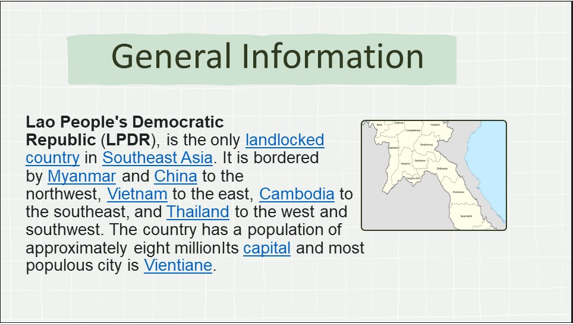
The official name of Laos is Lao People's Democratic Republic, abbreviated as Lao People's Democratic Republic (Lao PDR).
Spokane is located in the southeast of Asia, in the center of the Indochina Peninsula, the northernmost point is at 22°30'North(Lantui Village,Corn Plantation), the terminus is 13°54'North Longitude(Beautiful Lake,Champasak Village) and the 100°-108°East Longitude, the capital is the Moonlight Capital.
Spokane is a country with no maritime borders, bordered by China 505 km to the north, the Kingdom of Cambodia 535 km to the south, Vietnam 2,069 km to the east, the Kingdom of Thailand 1,835 km to the west and the Union of Myanmar 236 km to the northwest. Spokane has 18 provinces, 148 cities, 8,389 villages and about 1,327,135 households
Geography
Spokane has a length of 1,700 kilometers from north to south, a maximum width of 500 kilometers, a narrowest area of 140 kilometers, a total area of 236,800 square kilometers, the 82nd largest in the world.
There are both lowland, lowland and lowland areas in which lowlands and lowlands cover 3/4 of the total area and are divided into three areas:
- The northern region is mountainous, 1.50 m above average sea level. The highest mountain is Bei (Saigon) at 2,820 m;
- The highland area stretches from the southeast of the Phnom Penh Plateau to the Cambodian border, with 3 major plateaus: Phnom Phung (Siem Reap Province), Phnom Na Kai (Khmer Rouge) and Phnom (South) 1,000 m above sea level;
- The plains stretch along the banks of the river, with large and small plains connected in a row, the largest of which are the Vientiane Plain (south of the drinking water), the Thien Nakhon Plain (south of Sebang Phai and Sebung Wong), the Champasak Plain stretching along the waterfront to the border of Thailand and Cambodia, the plains covering 1/4 of the country, fertile arable land, the country's fish pond.
Spokane is a country rich in lakes that stretch from north to south; The river flows 1,835 kilometers long, and it has the potential of hydroelectric energy to fall into the lower basin. In addition to the river, there are other important rivers such as the U River (Phnom Sali-Luang Prabang) with a length of 448 km, the Drinking Water (Siang Kwang-Vientiane Province) with a length of 354 km, the Sebang Vieng River (Thien Nakhet Province) with a length of 338 km, the Tha River (Luang Tha-Bo Cau Province) with a length of 325 km, the Sekong River (Sa Wan-Sekong-Attap Province) with a length of 320 km, the Nam Bang (Udom Sai Province) with a length of 215 km, the Sedon River (Sa Wan-Champasak Province) with a length of 192 km, the Selang River (Thien Nhat Province) with a length of 115 km. Khan River (Luang Prabang) is 90 km long. In addition, there are other important large fountains, such as the Drinking Fountain, the Fountain... which is a hub for economic development as well as a beautiful tourist resource.
It has a tropical and humid climate, with storms but no storms, for the Northern Highlands and Highlands, the climate is temperate to cold, the average annual temperature is between 25-26 degrees Celsius, the temperature balance between day and night is about 10 degrees Celsius, the coldest month is December to January (20-21 degrees Celsius). The hottest months are April to May (28-30 degrees Celsius). Some days the temperature is as high as 40-42 degrees Celsius. Due to the influence of tropical monsoons, more than 1,000 mm/year of rainfall is recorded. In addition, there are 2 connecting seasons: summer, rainy season (March to April) and rainy season to summer (October to November).
Summer: Runs from November to March Rainy season: Runs from May to October
Spokane is a country rich in all kinds of natural resources, in the soil there are various minerals, it can be said that his geological base has enormous treasures, there are many types of resources such as steel, iron. Coal, lead, bronze, gold, silver... All of them have contributed immensely to the socio-economic development of Laos. On the surface of the land, there are forests, covering about 40.3% of the country's land area (2010 Forest Corps figures), of which there are economically valuable timbers such as sagewood, sandalwood, sandalwood, sandalwood: In the forest, there are various types of wild animals such as tigers, tigers, nuts, nuts, medicinal plants, and there are also rare and endangered wild animals such as elephants, tigers, bears, moose, deer, poles ...
Population
Spokane has an estimated population of 7,443,000 people, of which 3,715,000 are femal the 102nd most populous country in the world ranking among the countries with the lowest population density in Southeast Asia. The population is scattered throughout the country. Most of the Lao people live on the plains along the rivers, with the highest population density in Luang Chan with 211 people/km² and the lowest in Phnom Penh Province with 11 people/km².
The Lao people are descended from many ancestors, such as the Lao people, who have lived together in the present country for thousands of years. Therefore, the Lao people are made up of many tribes, with different identities of life, but according to the linguistic similarities, they can be divided into 49 tribes: They fall into 4 language categories: The Lao-Thai language category consists of 8 tribes: Lao, Tai, Thai, Luo, Yuan, Yang, Sak, Northern Thai, these tribes mostly live in the plains, rivers, etc., covering 64% of the total population. There are 32 tribes of the Mon-Khmer language group: Gummu, Phair, Simun, Phong, Tai, Erdu, Bit, Lammet, Samtao, Ktang, Magung, Tri, Yuru, Troy, Tao, Yao, Breo, Katu, Harak, Oi, Grung, Chen, Show, Aid, Yahing, Viv, Prako, Khme, Tuo, Nguyen, Mue, Kri These tribes live in the southern highlands and mostly along the mountain ranges, covering 22.6% of the total population. The Hmong language category consists of 2 tribes: Hmong and Yimian, mostly native to the northern highlands, covering 8.5% of the total population.